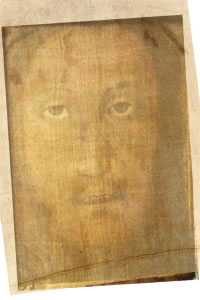
The first photograph of the shroud of Turin in 1898 revealed that it can be compared with a photographic negative. The sweat-cloth at Manoppello, on the other hand, is more like a slide. However, they are not photographs. The shroud of Turin bears the image of a dead man, while the sweat-cloth depicts a living man marked with the signs of his martyrdom.
The Capuchin friar Domenico da Cese (1905 – 1978) recognized matching facial features on the veil of Veronica and the shroud of Turin. Using orientation points, the Trappist nun Blandina Paschalis Schlömer, a German pharmacist and icon painter, developed an overlay technique known as superimposition. Based on the congruity, she was able to prove that the images on both cloths were of the same person. She later applied this technique to the sudarium of Oviedo with the same result.
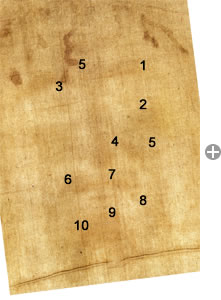
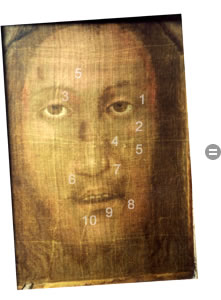
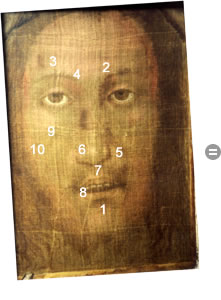
- 1 Left pupil
- 2 Left lower eyelid
- 3 Right pupil
- 4 Hematoma at the broken bridge of the nose
- 5 Puncture wounds from thorns on the left cheek and the right eyebrow and in the corner of the right orbital cavity
- 6 Right nostril
- 7 Left, injured nostril
- 8 Transverse and curved lines at the left corner of the mouth
- 9 Row of teeth, last visible tooth
- 10 Injury to the lower lip
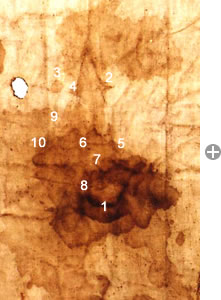
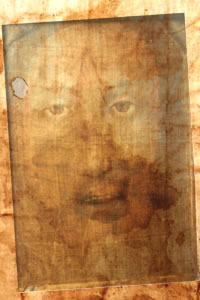
- 1 Cut between the two teeth visible on the cloth
- 2 Piercing of thorns between the middle and end of the left eyebrow
- 3 Stain over an injury of the right eyebrow
- 4 Diagonal line which is congruent with a bright red line in the sudarium of Manoppello
- 5 Configuration at the nose caused by a blow from a cudgel. There are parallel dark lines and a bright triangular line, the tip of which points downwards.
- 6 Horizontal line which is interrupted in places and delineates the lower boundary of the break in the middle of the nose
- 7 Abraded and crushed tip of the nose
- 8 Injury to the upper lip. One can see dark points in a straight line which projects slightly beyond the lip line and a clear reddening, which extends upwards from these possible puncture sites. An injury to the upper lip itself is also visible.
- 9 Trace of fluid which begins precisely at the site of the pupil. The eye appears to be injured by thorns.
- 10 Injury caused by thorns on the right cheek in the geometric form of a trapezoid with the tip pointing downwards